LIPOSONLINE.COM – In the era of digital transactions, the terms “bank API” and “payment gateway” are often used interchangeably. However, both serve different roles within the digital financial ecosystem.
Understanding the difference is important for business owners to choose the system that best fits their business needs.
What Are Bank API and Payment Gateway?
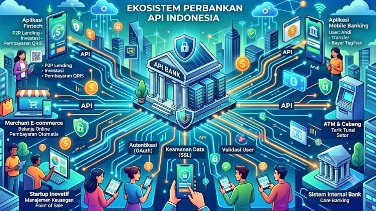
API stands for Application Programming Interface. Quoted by LIPOSONLINE.COM from various sources, a bank API is a technical bridge that connects an application directly to a bank’s system.
Through this connection, an application can send commands or retrieve data from the bank.
Read Also : What Is a Banking API? Its Functions, How It Works, and Why It Matters in the Digital Banking Era of 2026
Examples include checking balances, viewing transaction history, sending transfers, and generating virtual accounts. Meanwhile, a payment gateway is a service provider that connects businesses to various payment methods.
Through a single dashboard, merchants can accept payments via bank transfer, debit/credit cards, e-wallets, and QRIS. In simple terms, a bank API is like a direct highway to one specific bank.
A payment gateway, on the other hand, is like a terminal that consolidates multiple payment channels at once. For MSMEs, a payment gateway is usually more efficient because it does not require manual integration with each bank.
However, large companies that need full control, such as bulk transfer automation or internal financial reconciliation, will benefit more from a direct bank API integration.
How Secure Is a Bank API?
Because it is directly connected to financial data, a bank API is designed with high-level security. Both banks and third parties must meet certain technical standards before integration can proceed.
Common security measures include data encryption to prevent unauthorized access to information, as well as authentication using API keys, tokens, digital signatures, and security certificates.
Read Also : How AI Banking Innovations Redefined Customer Experience
Access is also restricted so that applications can only use permitted features. However, security is not solely the bank’s responsibility.
Data breaches can still occur if API credentials are leaked, third-party systems have weak security, or users fall victim to phishing.