For general users, the safest practices are to use official applications, never share OTPs and PINs, and avoid suspicious links.
5 Risks of Bank API to Be Aware Of
– Access Misuse – API credentials are stolen and used by unauthorized parties.
– Data Breach – Sensitive customer data can be exposed if a partner’s system is not secure.
– System Disruption – Errors in bank servers, applications, or service providers can cause transaction delays.
– Integration Errors – Incorrect configuration can lead to failed transactions or inaccurate status updates.
– Social Engineering – Fraudsters trick users into providing OTPs or passwords.
Understanding these risks is not meant to cause concern, but to encourage companies and users to be more vigilant in maintaining digital security.
Read Also : How 10 Years of Banking Tech Shifted Your Daily Finance
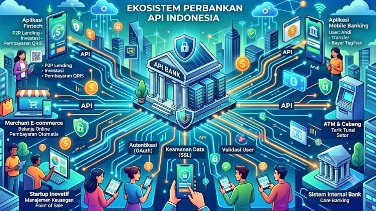
The Role of Bank API in Fintech, Marketplace, and CryptoIn fintech, bank APIs are used for fund disbursement, withdrawals, and retrieving transaction data.
In marketplaces, bank APIs accelerate payment status updates. When a buyer pays via virtual account, the system immediately detects the payment and processes the order automatically.
In payment gateways, bank APIs serve as the backbone that enables connection to multiple banks without requiring separate integrations.
In the crypto ecosystem, bank APIs are crucial for depositing and withdrawing Indonesian Rupiah. Users expect transactions to be fast and transparent.
If the process is slow, the user experience will suffer. Therefore, crypto platforms must maintain strict security and compliance standards.
The Future of Bank API in Indonesia
The trend of digital payments in Indonesia continues to grow, from mobile banking and QRIS to e-wallets and marketplaces.
Going forward, bank APIs will become increasingly linked to embedded finance — financial services embedded within non-banking applications.
Read Also : Cloud Banking: Why Banks Are Moving to the Cloud
For example, business applications that directly offer capital loans or cash flow management.
With the addition of AI and data analytics, financial services can also become more personalized. However, all of this requires a strong foundation of secure connectivity and data.
For the public, this means transactions will become even easier. At the same time, digital literacy must also improve to ensure personal data and funds remain secure.
Conclusion
In summary, a bank API is the link between applications and banking systems that enables financial services to operate faster, automatically, and securely.
Through an API, functions such as balance checks, payment verification, transaction history retrieval, virtual account creation, and fund transfers can be performed directly.