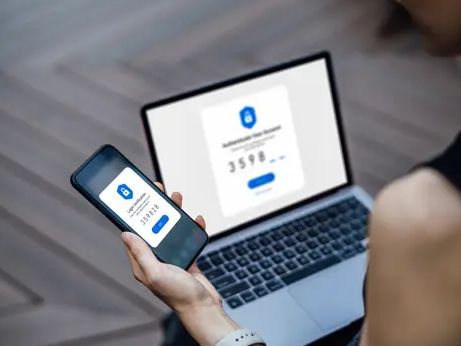
LIPOSONLINE.COM- Online banking has made payments, transfers, and account management much easier, but it has also created more opportunities for cybercriminals. Multi Factor Authentication Banking adds another security layer by requiring customers to prove their identity through more than just a password. With password-based attacks still making up more than 99% of the 600 million daily identity attacks observed by Microsoft, stronger authentication is becoming increasingly important.
What Is Multi Factor Authentication Banking?
Multi Factor Authentication Banking (MFA Banking) is a security method that requires customers to provide at least two different types of authentication before accessing an online banking account or completing certain transactions.
Instead of relying only on a username and password, banks can combine several authentication factors, such as:
- Something you know: a password, PIN, or security question.
- Something you have: a smartphone, authentication app, security token, or registered device.
- Something you are: a fingerprint, facial recognition, or another biometric identifier.
The idea is simple: if one security factor is compromised, the attacker still needs another factor to gain access.
Read Also : Inside Biometric Security: How Banks Verify You
Microsoft has reported that multi-factor authentication can reduce the risk of account compromise by 99.2% based on real-world Microsoft Entra data. That makes MFA one of the most valuable security controls available to financial institutions and their customers.
Why Multi Factor Authentication Banking Matters
Banking accounts contain highly sensitive information and are directly connected to financial transactions. A stolen password can therefore become much more serious than a compromised account on an ordinary website.
The growing importance of MFA can also be seen in current breach data. Verizon’s 2026 Data Breach Investigations Report found that credential abuse accounted for 13% of breaches, while vulnerability exploitation became the leading initial access vector at 31%.
This does not mean MFA can solve every cybersecurity problem. Instead, it helps reduce the risk associated with stolen or reused credentials.
The Password Problem
Passwords remain one of the weakest parts of digital security. People may reuse passwords, choose predictable combinations, or accidentally disclose them through phishing attacks.
Microsoft reported approximately 600 million identity attacks per day, with more than 99% being password-based attacks. Microsoft also reported blocking around 7,000 password attacks every second during the period covered by its Digital Defense Report.
For banks, this creates a strong reason to move beyond password-only authentication.
How Multi Factor Authentication Works in Banking
The exact process depends on the bank and the transaction, but the basic concept is straightforward.
A customer might first enter a username and password. The bank then requests a second verification step, such as a one-time code sent through an approved channel, confirmation through a banking application, or biometric verification.
For example, a typical login can involve:
- The customer enters their username and password.
- The banking system checks the credentials.
- A second authentication factor is requested.
- The customer confirms their identity.
- Access is granted if the verification succeeds.
For higher-risk transactions, the bank may request additional confirmation. This can be particularly useful when a customer attempts to transfer money, change account information, or register a new device.
Common Types of Multi Factor Authentication Banking
Different MFA methods offer different balances between security, convenience, and accessibility.
1. One-Time Passwords
One-time passwords, often called OTPs, are temporary codes used for authentication. A code may be generated by an authentication application or delivered through another approved channel.
The main advantage is that the code is temporary. Even if someone sees an old code, it should not remain valid indefinitely.
However, OTPs are not completely immune to phishing or social engineering. Customers should never provide authentication codes to someone claiming to be a bank representative without independently verifying the request.
2. Banking App Confirmation
Some financial institutions allow customers to approve login attempts or transactions directly inside their banking application.
This method can provide a smoother experience because customers do not always need to manually enter a code.
It can also help banks connect authentication with transaction information, allowing users to review what they are approving before confirming it.
3. Biometric Authentication
Biometrics use characteristics such as fingerprints or facial recognition to verify identity.
This approach is increasingly common on smartphones because it can be fast and convenient. It also reduces dependence on memorized passwords.
However, biometric authentication should normally be treated as one component of a broader security system rather than a complete solution by itself.
4. Hardware Security Keys
Security keys are physical devices designed to provide strong authentication. They can offer significant protection against certain phishing attacks because authentication is tied to the legitimate website or service.
Although they are generally more common in high-security environments, the underlying technology demonstrates how banking authentication can evolve beyond traditional passwords and codes.
Multi Factor Authentication Banking and Fraud Prevention
MFA is particularly valuable because financial fraud often begins with compromised credentials.
Verizon’s research found that compromised credentials were an initial access vector in 22% of breaches in its 2025 DBIR dataset. Its analysis also found credential stuffing represented a median 19% of authentication attempts among analyzed SSO provider logs, reaching 25% in enterprise-sized organizations.
These figures demonstrate why password protection alone is increasingly insufficient.
When MFA is implemented correctly, a stolen password does not automatically provide access. The attacker must overcome another authentication layer, increasing the difficulty of account takeover.
Benefits of Multi Factor Authentication Banking
MFA provides several important benefits for both banks and customers.
Stronger Account Protection
The biggest benefit is the additional barrier between an attacker and an account. Microsoft estimates that MFA can reduce compromise risk by 99.2%.
Reduced Credential-Based Risk
If a password is exposed in a data breach somewhere else, MFA can help prevent that password from being enough to access a banking account.
Better Protection for High-Risk Transactions
Banks can use stronger authentication when transactions appear unusual or involve sensitive account changes.
Greater Customer Confidence
Security is also part of the customer experience. Customers are more likely to trust digital banking when they know their accounts have multiple layers of protection.
Challenges of Multi Factor Authentication Banking
MFA is powerful, but it is not perfect.
One challenge is customer convenience. If authentication takes too many steps, customers may find digital banking frustrating.
Another challenge is social engineering. Attackers may attempt to manipulate customers into approving fraudulent authentication requests.
There is also the issue of device loss or replacement. Banks need secure account-recovery procedures that do not accidentally create a new vulnerability.