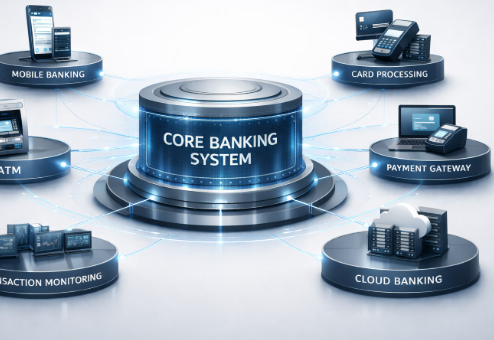
IBM’s research found that 94% of 700 global business leaders surveyed said their bank was behind schedule on core platform modernization.
Several factors contribute to this problem.
High Implementation Costs
Replacing a core platform can require significant investment in software, infrastructure, consultants, employee training, testing, and migration.
Data Migration
Moving years or decades of customer and transaction data is complicated. Even a small migration error can create serious operational problems.
Regulatory Requirements
Banks must comply with extensive financial regulations. A modernization project therefore needs to preserve auditability, security, data governance, and regulatory controls.
Operational Risk
Banks cannot simply shut down their core infrastructure for an extended period. Migration often needs to happen gradually while existing services continue operating.
Choosing the Right Core Banking Software
Financial institutions should evaluate more than the software’s feature list before making a decision.
Read Also : The Future of Core Banking System 2026: Cloud, API, AI and Real-Time Banking Trends
Important considerations include:
- Scalability
- Security architecture
- API capabilities
- Cloud compatibility
- Vendor support
- Integration options
- Regulatory compliance
- Data migration tools
- Total cost of ownership
- Customization requirements
- Disaster recovery capabilities
Packaged core banking solutions can provide pre-built functionality and regular vendor updates, while highly customized or internally developed systems can offer greater control but may involve additional complexity and longer implementation timelines.
The Future of Core Banking Software
The future of core banking software is likely to be shaped by cloud computing, artificial intelligence, APIs, automation, real-time payments, and modular architectures.
AI is particularly interesting because it can support areas such as fraud detection, customer service, software development, risk analysis, and operational automation. However, AI cannot fully compensate for weak underlying infrastructure.
This is why modernization and AI adoption are increasingly connected. IBM’s 2025 research emphasizes that banks need to rethink architecture, operating models, governance, and data management alongside AI adoption.
Another important trend is hybrid cloud. IBM reported that 90% of organizations are expected to adopt a hybrid-cloud approach through 2027, reflecting the continuing importance of combining cloud flexibility with existing infrastructure and regulatory requirements.
Conclusion
Core banking software is much more than a backend database. It is the operational foundation that allows financial institutions to manage accounts, process transactions, deliver loans and deposits, connect digital channels, and maintain consistent customer experiences.
The technology is also changing rapidly. Legacy platforms that were once sufficient for branch-based banking increasingly face pressure from instant payments, mobile applications, open APIs, cloud services, and customers who expect financial services to work in real time.
The numbers show both the opportunity and the difficulty. The core banking software market is projected to grow at 17.4% CAGR, while IBM’s research shows that 94% of surveyed global business leaders reported delays in core modernization.