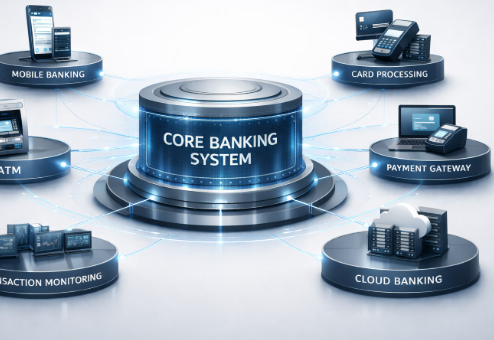
LIPOSONLINE.COM – Behind every smooth bank transfer, mobile banking login, loan payment, and account update, there is a powerful system working in the background. That system is often core banking software. It connects essential banking operations, keeps financial records synchronized, and helps customers access services across branches and digital channels.
The importance of this technology is growing as banks move toward real-time services, cloud infrastructure, APIs, automation, and increasingly digital customer experiences. The global core banking software market was valued at approximately $19.30 billion in 2025 and is projected to reach $80.65 billion by 2034, representing a projected CAGR of 17.4%.
What Is Core Banking Software?
Core banking software is the central technology platform used by banks and other financial institutions to manage essential banking activities. Instead of keeping customer and transaction information isolated in individual branches, the system provides a centralized environment where financial data and operations can be processed consistently.
Typical functions include:
- Customer account management
- Deposit and withdrawal processing
- Loan and credit management
- Interest calculation
- Payment processing
- Transaction recording
- Customer information management
- General ledger and financial reporting
- Compliance and risk-related processes
In practical terms, when a customer transfers money through a banking application, the mobile application is not usually responsible for maintaining the underlying account balance itself. It communicates with backend banking systems that authenticate the request, process the transaction, update records, and return the appropriate result.
This centralized approach is one of the main reasons core banking software has become the backbone of modern financial institutions. IBM describes core banking as a centralized backend connection that supports services such as accounts, deposits, withdrawals, loans, and customer management.
How Core Banking Software Works
A typical core banking environment involves several connected layers rather than one isolated application.
1. Customer and Account Management
The first layer manages customer profiles and financial accounts. It keeps track of account ownership, balances, account status, transaction history, and other relevant information.
Because this information is centralized, a customer can potentially access the same account through multiple channels, including a branch, ATM, website, or mobile application.
2. Transaction Processing
Transaction processing is another critical component. The software validates requests and updates account records when customers make transfers, deposits, withdrawals, or payments.
Speed matters here. Modern customers increasingly expect banking transactions to happen almost immediately rather than waiting for traditional batch-processing cycles.
3. Loan and Deposit Management
Core platforms can also manage lending and deposit products. Depending on the institution and software configuration, this can include loan applications, repayment schedules, interest calculations, deposits, and account maturity processes.
4. Integration With Other Banking Systems
Modern core platforms rarely operate alone. They can connect with payment systems, fraud detection tools, customer relationship platforms, mobile applications, analytics platforms, and external financial services through APIs and integration layers.
This connectivity is becoming especially important as banks build broader digital ecosystems.
Key Features of Core Banking Software
A strong core banking software platform normally combines several capabilities in one architecture.
Real-Time Banking
Real-time processing allows account information and transactions to be updated rapidly. This is particularly important for digital banking and instant-payment environments.
The Federal Reserve Bank of Kansas City notes that many older core systems were not designed to fully support newer services such as open banking and instant payments.
Account Management
Account management provides the foundation for customer banking services. Banks can use the platform to manage different account types, balances, transaction histories, and account-related changes.
Loan Management
Loan modules can support the lifecycle of lending products, from application and approval through repayment. Automated calculations can also reduce manual work and improve consistency.
Security and Authentication
Security is another major component. Modern platforms can integrate encryption, authentication, authorization, fraud monitoring, and audit capabilities.
A centralized platform can make security controls easier to manage, although centralization also means that protecting the core environment becomes extremely important.
API and Digital Integration
API connectivity allows core banking platforms to communicate with mobile apps, fintech services, payment networks, and other business systems.
This flexibility is increasingly important because customers often interact with their bank through digital channels rather than directly through a traditional branch.
Benefits of Core Banking Software
1. Better Customer Experience
One of the biggest advantages is the ability to provide consistent services across multiple channels.
Customers can check balances through an app, visit a branch, use an ATM, or access online banking without needing completely separate account records.
IBM’s 2025 research found that 49% of banking CIOs reported significant improvements in client experience from more aggressive front-to-back modernization approaches.
2. Faster Product Development
Modern core platforms can make it easier for banks to introduce new financial products.
Cloud-native architecture, APIs, and modular components can reduce dependence on tightly connected legacy applications. This can help institutions experiment with new products without rebuilding their entire infrastructure.
IBM reported that 46% of surveyed banking CIOs saw significant improvements in the frequency of system updates through modernization. Another 46% reported improvements in data access efficiency.
3. Improved Operational Efficiency
Automation can reduce repetitive manual processes. Instead of employees entering and reconciling information across multiple systems, centralized platforms can synchronize data and automate routine workflows.
This can potentially improve processing speed, reduce operational friction, and allow employees to spend more time on higher-value activities.
4. Greater Scalability
A modern system can be designed to support increasing numbers of customers, transactions, products, and digital channels.
Cloud-based deployment can provide additional flexibility because computing resources can be adjusted as demand changes. However, scalability still depends on architecture, infrastructure, vendor capabilities, and effective system design.
Core Banking Software and Cloud Technology
Cloud technology has become one of the most important trends in banking modernization.
Traditional systems often depend on on-premises infrastructure and older architectures. Modern cloud-native platforms can provide greater flexibility, automated deployment, elastic infrastructure, and easier integration with other services.
However, moving to the cloud does not automatically guarantee better results.
IBM’s research shows the complexity involved. 73% of surveyed banking CIOs reported that managing costs for system updates and modifications became harder, while 69% said maintaining adequate risk management became harder.
That means cloud migration should be treated as a strategic transformation rather than simply moving existing applications from a bank’s servers to a cloud provider.
Legacy Systems vs. Modern Core Banking Software
Many financial institutions still operate legacy core systems because replacing them is expensive and risky.
The Federal Reserve Bank of Kansas City notes that some financial institutions continue to use legacy core systems that can be up to 40 years old.
Legacy Systems
Legacy platforms can provide stability and proven functionality, but they may have limitations such as:
- Difficult integration with modern APIs
- Expensive maintenance
- Limited flexibility
- Older programming technologies
- Slower product development
- Challenges supporting real-time services
Modern Platforms
Modern core banking software typically focuses on:
- Cloud-native architecture
- Modular components
- API connectivity
- Real-time processing
- Automated deployment
- Data integration
- Improved scalability
The goal is not simply to replace old technology with new technology. The bigger objective is to create a banking infrastructure that can adapt to changing customer expectations and business requirements.
Challenges of Core Banking Modernization
Modernization sounds straightforward until a bank has to change the system responsible for millions of customer accounts and transactions.