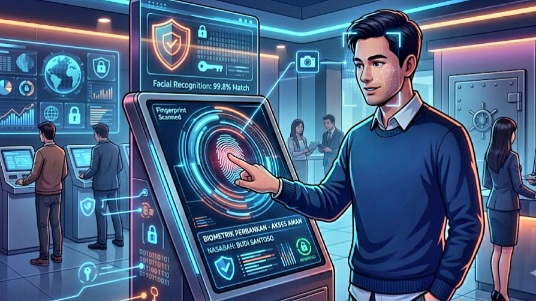
Entering 2026, the attacks have leveled up. The rise of deepfakes, AI-powered password attacks, and large-scale data breaches means banks must add an additional layer of security.
Digital banks like BCA, BNI, Mandiri, BSI, and even neobanks like SeaBank and Jago now require biometrics for important activities.
During account registration, prospective customers are required to submit a selfie with their ID card and perform a blink test to verify that they are a real, live person.
Read Also : Reses II DPRD Lubuk Linggau: Septrian Nugraha Salurkan Bantuan dan Gelar Turnamen SNG Merdeka Cup 2026
4 Major Benefits of Biometrics for the Banking Industry
- Multi-Layered Security and Hard to Forge
Every individual has a unique fingerprint and iris pattern. This data also cannot be guessed like a password “123456”.
With AI, the system can also detect whether a scanned face is real or a deepfake video.
- Operational Efficiency and Cost Savings
Banks no longer need to send officers to a customer’s home for verification. Digital KYC with biometrics can be done 24/7. This cuts costs and time by up to 80%.
Read Also:Will AI Replace Traditional Banking Jobs? The Real Truth
- Seamless Customer Experience
Picture this: it’s midnight and you need to transfer money. Just open the app, tap your finger, and you’re done. No need to hunt for a token or wait for a delayed SMS OTP. This makes customers feel served in a modern way.
- Reducing Fraud and Fake Accounts
With biometrics, one person can only have one valid account. This greatly helps banks curb illegal online lenders and job scam fraud that uses other people’s ID cards.
Types of Biometric Technology Used by Banks Today
Not all biometrics are the same. Here are the most commonly used types in the financial industry:
- Fingerprint Recognition
The most popular. Sensors are already in every smartphone. Pros: cheap, fast, highly accurate. Cons: can fail if fingers are wet or injured.
Read Also: Private Banking: Everything You Need to Know
- Facial Recognition
This technology analyzes 80+ points on the face. Banks use it for login and e-KYC. The latest versions include “liveness detection” to prevent fraud using photos or videos.
- Iris Recognition
The iris pattern is extremely complex and remains unchanged throughout a person’s lifetime. This is considered one of the most accurate biometric technologies globally.