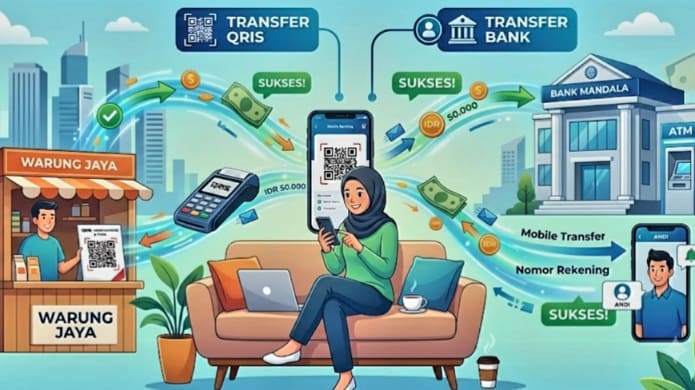
The Future: Growing Together, Not Replacing Each Other
QRIS will continue to grow because it’s simple and fast. But bank transfers will remain the foundation of finance, especially for corporations and large transactions.
‘
The choice is not about which is superior, but about which best suits your needs at the time.
Read Also : The CBDC Impact on Traditional Banking Explained
Detailed Comparison: QRIS vs Bank Transfer
1. Ease of Use
QRIS is simpler because you just need to scan the code, without typing any account number.
Meanwhile, bank transfers require you to manually enter the recipient’s account number and follow several steps
2. Transaction Speed
A QRIS transaction is generally completed in a matter of seconds after payment confirmation.
Bank transfers using BI-FAST are also fast, but the process of inputting account details makes it take a bit longer.
3. Payment Accuracy
The risk of sending money to the wrong person with QRIS is very low because the funds go directly to the merchant’s code.
Read Also : Update Harga Emas Antam 2 Agustus 2026: Tak Bergerak, Buyback di Rp2.368.000
With bank transfers, there’s a risk of error if you mistype even one digit of the account number.
4. Flexibility
QRIS can only be used if the merchant provides a QR code. Now faster and more affordable with BI-FAST, which enables real-time settlement.
5. Large Transactions
QRIS is more suitable for daily purchases with small to medium amounts. Bank transfers are better for large payments such as property, invoices, salaries, and business needs.