Getting to Know Bank Transfers: The Backbone of Digital Transactions
What is a Bank Transfer?
A bank transfer is the process of moving funds from one bank account to another through the banking network.
It has been the main payment method for decades.
Read Also : Neobank vs Digital Bank: What’s the Real Difference?
Previously you had to visit a branch and fill out forms. Now you can do it via ATM, internet banking, mobile banking, SMS banking, and BI-FAST — available 24/7 from home.
Types of Bank Transfers
1. Intra-bank Transfer
Between accounts in the same bank. Usually instant and free.
2. Inter-bank Transfer
To a different bank. Now faster and more affordable with BI-FAST, which enables real-time settlement.
3. BI-FAST
Bank Indonesia’s real-time payment system. Enables interbank transfers 24/7 with a fee of only IDR 2,500.
Read Also : What Is a Neobank? A Simple Guide to Modern Digital Banking
4. RTGS
For large transactions above IDR 100 million. Common for corporate payments. More formal process and higher fees.
5. SKN/Clearing
For non-real-time interbank transfers. Often used for payroll and bulk company payments.
How Modern Bank Transfers Work
Enter destination account number > system verifies name > funds deducted > funds sent via banking network > recipient receives funds + notification. With BI-FAST, this can be completed within seconds.
Advantages of Bank Transfers
– Universal: Accepted by schools, universities, companies, and marketplaces
– Best for Large Amounts: Ideal for buying property, cars, paying vendors, and salaries
– Strong Proof of Payment: Includes reference number, recipient name, and date. Great for accounting
– High Trust Level: Regulated and supervised by OJK and Bank Indonesia
– No QR Needed: Only requires the recipient’s account number
Read Also : Top-Rated Online Banking Apps for Fast Banking
Disadvantages of Bank Transfers
– Prone to Input Errors: One wrong digit can send money to the wrong account
– More Steps: Select bank, enter account number, verify name, confirm
– Fees Still Apply: Even with BI-FAST, some banks still charge admin fees
– Risk of Wrong Transfer: Human error is the most common issue
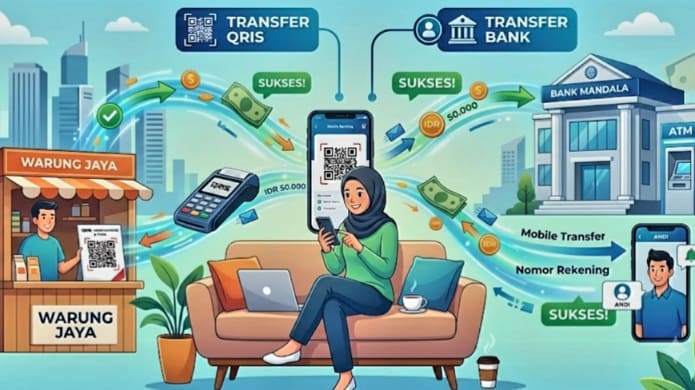
When to Use QRIS? When to Use Bank Transfer?
Use QRIS for:
Daily shopping, food and drinks, parking, and transactions at MSMEs.
Anything fast where you don’t want to type an account number.
Use Bank Transfer for:
Sending money to family, paying tuition, paying vendors, payroll, buying assets, and business transactions.
Anything that requires formal proof and large amounts.