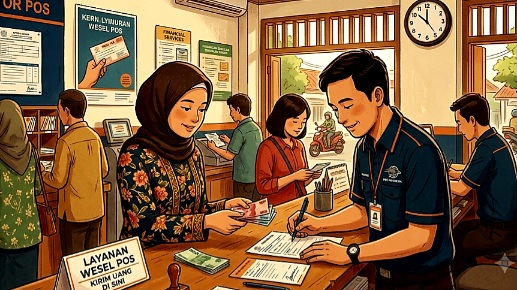
These remittance flows contribute to household consumption, strengthen local economies, and support regional economic development.
Supporting Micro, Small, and Medium Enterprises (MSMEs)
Micro, Small, and Medium Enterprises (MSMEs) are widely regarded as the backbone of Indonesia’s economy.
However, not all MSME owners have full access to formal banking services.
Under these circumstances, money orders provide a practical alternative for conducting financial transactions.
Business owners can receive payments from customers and make payments to suppliers without the need for a bank account.
This convenience helps maintain commercial activities, particularly in areas where digital financial services are still underdeveloped.
Furthermore, the relatively affordable service fees associated with money orders make them an attractive option for small businesses managing their cash flow.
Facilitating the Distribution of Social Assistance
The Indonesian government and various social organizations also utilize money order services to distribute financial assistance to the public.
Social welfare benefits, educational scholarships, charitable aid, and certain honorarium payments can all be delivered through Indonesia’s extensive network of post offices.
With post offices operating across thousands of districts, residents in remote areas can receive financial assistance without first opening a bank account.
This approach is considered highly effective because it enables financial assistance to be delivered directly to eligible recipients.
An Alternative Method for Bill Payments
Although utility bills are increasingly paid through digital platforms, money orders continue to serve as an alternative payment method for services such as electricity, clean water, and telecommunications.