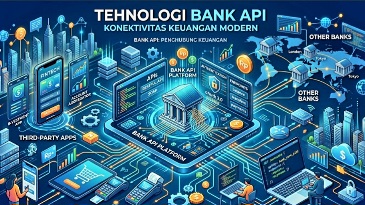
Every API connection must go through registration, partnership agreements, technical testing, and compliance with national security standards.
Four Everyday Examples of Banking API Applications
1. Mobile Banking
When users open a mobile banking application to check their account balance, the app retrieves the data from the bank’s servers through APIs.
2. E-Wallet Top-Ups
When topping up digital wallets such as DANA, OVO, or GoPay, the e-wallet platform uses Banking APIs to validate the payment. Once verified, the user’s balance is updated instantly.
Read Also : The Future of Banking: Why AI Changes Everything
3. QRIS Payments
Banking APIs integrate banks, digital wallets, and merchants into a unified payment ecosystem.
When a customer scans a QR code, the payment request is processed, verified, and confirmed within seconds.
4. Investment and Cryptocurrency Applications
When users deposit or withdraw funds, Banking APIs automatically verify incoming payments and send transfer instructions to the designated bank accounts.
Key Functions of Banking APIs in the Digital Financial Ecosystem
Banking APIs do much more than simply connect systems. Their primary functions include:
1. Transaction Automation
Bank transfers, bill payments, deposit validation, and financial reconciliation can all be performed automatically without manual intervention.
2. Faster Payment Confirmation
For online businesses, speed is essential. APIs enable payment statuses to be updated within seconds, reducing customer complaints and minimizing order cancellations.
3. Reduced Operational Errors
Manual data entry errors and delayed transaction verification are significantly reduced because all processes are handled automatically by the system.