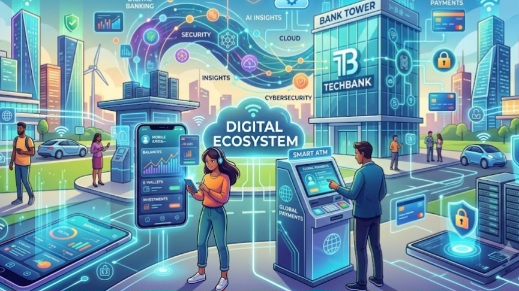
LIPOSONLINE.COM –Before digital wallets, people used to have to go to a bank branch to transfer money, pay utility bills, apply for loans, or even just check their balances. Long lines at the teller, carrying deposit slips, and waiting for bank opening hours were all normal parts of life.
Now, all of that can be done from the palm of your hand. This is the major shift brought by financial technology, or fintech, over the last decade.Although the term “fintech” has existed for several decades, its real impact only started to be felt in 2015.
Financial technology has cut down the distance, time, and bureaucracy between people and financial services. From big cities to remote villages, anyone can now access bank accounts, loans, investments, and even insurance — all through an app.
From ATMs to KlikBCA: The Early Footprints of Fintech in Indonesia
If we look back, the earliest form of fintech in Indonesia actually began with the ATM. Anjungan Tunai Mandiri, or Automated Teller Machine, was the technology that allowed customers to transact without meeting a bank officer.
The first ATM was invented in the United States in 1961. In Indonesia, the machine was introduced in 1987 by Bank Niaga. A year later, BCA followed. Other banks then raced to install ATMs in various locations.
However, in the beginning, people did not immediately accept it.Many customers still preferred to queue at the counter. Reasons varied, from fear of pressing the wrong button, fear of the card being swallowed, to distrust in the machine’s security.
It took about 10 years and massive education campaigns from banks for people to get used to it. It was only in the late 1990s that ATMs became commonplace. The next stage was e-banking or internet banking.
Bank Internasional Indonesia was the first bank to launch this service in September 1988. But the service was not yet widespread because internet access in Indonesia at the time was still limited.
The real surge came in 2001 when BCA launched KlikBCA. This was the first internet banking service that was truly widely adopted by the public. KlikBCA’s advantage was not only in its features, but also in its education strategy.
According to marketing expert Hermawan Kartajaya, BCA was not the first bank to have ATMs and internet banking, but BCA was the first to conduct systematic education.