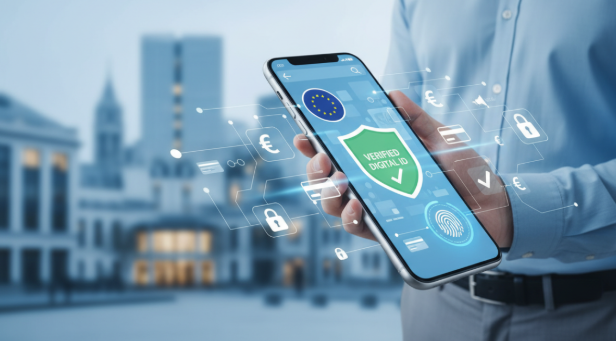
LIPOSONLINE.COM – Opening a bank account usually means proving who you are, submitting personal information, and completing several verification steps. Digital identity wallets could simplify that process by allowing customers to keep verified identity credentials on a smartphone and share only the information a bank actually needs.
The concept is still developing across many markets, but the direction is becoming clearer. Instead of repeatedly uploading identity documents to different financial institutions, customers could use a trusted digital identity wallet to verify themselves, authorize payments, and access banking services.
What Is a Digital Identity Wallet?
A digital identity wallet is a secure application that allows people to store, manage, and share verified digital credentials.
Think of it as a digital version of an identity folder rather than simply another payment wallet. Depending on the system, it could contain information such as:
- Verified personal identity
- Government-issued credentials
- Address information
- Professional qualifications
- Age-related attributes
- Digital signatures
- Other trusted credentials
The important difference is that the wallet does not necessarily need to reveal everything about the user.
For example, if a service only needs to confirm that someone is over a particular age, the wallet could potentially prove that attribute without sharing the person’s complete date of birth.
The European Union’s Digital Identity Wallet framework specifically supports this concept of selective disclosure, allowing users to share particular attributes without unnecessarily revealing additional personal information.
How Digital Identity Wallets Could Work in Banking
The basic banking workflow could be relatively straightforward. A customer would first obtain a trusted digital identity wallet and have their identity credentials issued or verified by an authorized identity provider.
When the customer wants to use a banking service, the bank could request specific information from the wallet. The customer would review the request and approve the data sharing.
The bank would then receive the necessary verified information and use it to continue the banking process.
A simplified workflow could look like this:
- The customer opens a banking service.
- The bank requests specific identity information.
- The wallet displays what information the bank wants.
- The customer approves the request.
- Verified credentials are transferred securely.
- The bank validates the credentials.
- The customer completes the requested service.
This approach could reduce repeated identity checks while giving customers greater control over their information.
Digital Identity Wallets for Bank Account Opening
One of the clearest potential applications is digital account opening. Today, customers may need to enter personal information, upload identification documents, take selfies, and wait for verification.
A digital identity wallet could change the process. Instead of manually entering the same information, a customer could select the identity credentials stored in the wallet and authorize the bank to access them.
The bank could then receive verified information needed for its customer onboarding process.
The European Commission already identifies opening a bank account as a specific EU Digital Identity Wallet use case. Its framework describes wallets being used to verify a person’s identity when opening an account online.
That could make digital onboarding less repetitive and potentially reduce the number of separate verification steps.
Why This Could Matter
The biggest advantage would not simply be speed.
A reusable digital identity could create a more consistent verification experience across different financial institutions.
Instead of providing the same information repeatedly, customers could potentially reuse trusted credentials.
For banks, this could reduce some manual data collection and help standardize onboarding workflows.
Digital Identity Wallets and KYC
Know Your Customer, or KYC, is a major part of banking operations.
Banks need to establish customer identity and collect appropriate information before providing certain services.
Digital identity wallets could become an additional technology layer within this process.
A bank might request:
- Full legal identity
- Verified address
- Date of birth
- Relevant identity credentials
- Other information required by applicable regulations
The wallet could then provide the requested credentials in a digitally verifiable format.
However, a wallet would not automatically replace KYC.
Banks would still need to perform the checks required by applicable laws and regulations. The wallet could instead make the collection and verification of trusted information more efficient.
This distinction is important because digital identity technology supports compliance; it does not remove the bank’s responsibility for compliance.
Payment Authentication Through a Digital Identity Wallet
Another interesting use case is payment authentication.
Instead of using separate authentication methods for different banking services, a digital identity wallet could become a trusted authentication layer.
For example, when authorizing an online payment, the bank or payment provider could request confirmation through the wallet.
The customer would review the transaction and approve it using the wallet’s security mechanism.
The EU’s current Digital Identity Wallet work specifically includes payment authentication. Official documentation describes the wallet being used to authorize online and in-store payments while working with existing payment infrastructure.
The scale of the payment environment explains why this matters. The European Commission reports that 86% of EU adults made an online purchase in the previous year, while around 150 billion non-cash transactions occurred in the euro area during 2024.
These figures show how large the potential environment is for secure digital authentication.
Selective Disclosure and Banking Privacy
One of the most interesting features of digital identity wallets is selective disclosure.
Traditional identity documents often contain much more information than a service actually needs.
Imagine a bank needs to confirm a customer’s age but does not need the customer’s exact birth date.
Instead of sending the complete identity record, a wallet could provide a verified statement confirming that the customer meets the required age threshold.
The same concept could apply to other information.
A bank might need to verify:
- Identity
- Residency
- Address
- Eligibility
- Professional status
The wallet could provide only the required attribute rather than exposing an entire collection of personal information.
The European Commission describes this as a way to give users greater control over what they share and reduce unnecessary data exposure.
Security Features of Digital Identity Wallets
A banking identity wallet would need strong security because it could become an important gateway to financial services.