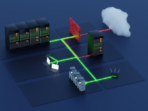
According to the Association of Certified Fraud Examiners’ 2024 Occupational Fraud report, organizations lose an estimated 5% of annual revenue to occupational fraud, based on its global study of fraud cases. This figure concerns occupational fraud rather than payment fraud specifically, but it illustrates why organizations continue investing in monitoring and control systems.
Real-time pipelines do not eliminate fraud. Their role is to make relevant information available quickly enough for automated controls and human investigators to respond.
Real-Time Analytics in Digital Banking
Real-time pipelines also support customer-facing services.
A mobile banking application may need current information about:
- Account balances
- Recent transactions
- Payment status
- Security alerts
- Transfer confirmations
Customers generally expect these updates to appear quickly.
This creates a technical requirement for banking systems to move information efficiently between backend applications and customer-facing platforms.
The growth of digital banking makes this increasingly important. According to the World Bank’s Global Findex 2021, 76% of adults worldwide had an account at a bank, other financial institution, or mobile money provider, up from 68% in 2017.
As more people use digital financial services, the amount of data generated by these services also increases.
The Role of APIs in Banking Data Pipelines
APIs help different banking applications communicate with each other.
A real-time pipeline may use APIs when a service needs to request or send information directly.
For example, a mobile banking application could use an API to request the latest transaction status from a backend service.
APIs and event streaming are not necessarily competing technologies. They can work together.
An API is often useful when one application needs to request specific information, while event streaming is useful when information needs to be distributed continuously to multiple consumers.
Challenges Banks Face When Building Real-Time Pipelines
Building a real-time data pipeline is more complicated than simply connecting applications.
Legacy Systems
Banks often operate systems that were developed at different times using different technologies.
Connecting older applications with modern streaming infrastructure can require additional integration layers.
Data Quality
A fast pipeline is not useful if the data entering it is incomplete or incorrect.
Banks need validation, standardization, and monitoring to maintain data quality.
Security
Banking data is highly sensitive.
Real-time pipelines need appropriate:
- Encryption
- Authentication
- Authorization
- Access controls
- Monitoring
- Audit trails
Security must be considered throughout the pipeline rather than added at the end.
Scalability
Transaction volumes can change significantly.
A pipeline designed for normal traffic needs to handle periods of higher activity without creating unacceptable delays.
Cloud infrastructure, distributed processing, and scalable streaming platforms can help address this challenge.
How Banks Measure Real-Time Pipeline Performance
Banks need measurable indicators to understand whether a pipeline is working properly.
Important metrics include:
Latency
Latency measures how long it takes for data to travel from its source to the required destination.
Lower latency is generally important for transaction monitoring and time-sensitive services.
Throughput
Throughput measures how much data the pipeline can process within a specific period.
For example, a system may be measured in events per second.
Availability
Availability measures how consistently the pipeline remains operational.
For critical banking services, even short disruptions can affect customers and downstream systems.
Error Rate
Banks can monitor failed events, rejected messages, duplicate records, and processing errors.
A reliable pipeline needs both speed and accuracy.
The Future of Real-Time Banking Data
Real-time data infrastructure is becoming increasingly connected to artificial intelligence, machine learning, cloud computing, and advanced analytics.
AI systems need timely data to produce useful results. If information arrives too late, an analytical model may not be able to support a decision when it matters.
This is why modern banking architectures increasingly combine:
- Event streaming
- APIs
- Cloud infrastructure
- Data platforms
- Machine learning
- Real-time analytics
- Automated monitoring
The goal is not simply to process data faster. Banks need to make information available to the right system at the right time while maintaining security, reliability, and regulatory controls.
Final Thoughts
How Banks Build Real-Time Data Pipelines is ultimately a story about how financial institutions move information through complex technology environments.
A modern pipeline can collect events from banking applications, stream them through distributed systems, process them in real time, store the results, and make them available to other services.
These pipelines support important functions such as fraud monitoring, transaction processing, digital banking, customer notifications, and real-time analytics.
The technology also comes with challenges. Legacy systems, data quality, security, scalability, and reliability all need to be addressed before a real-time architecture can operate effectively.