LIPOSONLINE.COM – Core banking migration is one of the most complex technology transformations a financial institution can undertake. It involves moving critical banking functions, customer records, balances, transaction histories, products, and integrations from an existing platform to a new environment while keeping daily banking operations running.
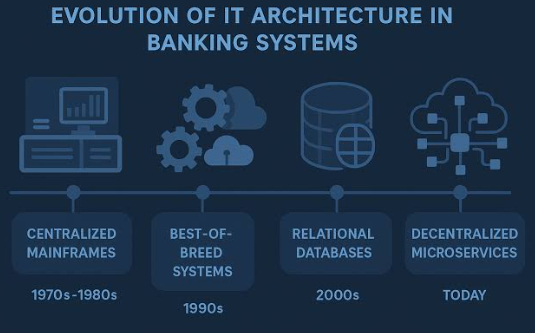
For many banks, the motivation is clear: legacy systems can be difficult to integrate, expensive to maintain, and poorly suited to real-time digital services. The Federal Reserve Bank of Kansas City notes that some financial institutions still operate core systems that are up to 40 years old, while modern platforms increasingly use modular architectures, APIs, and cloud infrastructure.
A successful Core Banking Migration is therefore not simply a software replacement. It is a carefully managed transformation involving technology, data, operations, employees, customers, risk, and compliance.
What Is Core Banking Migration?
Core Banking Migration is the process of transferring banking operations and information from an existing core banking platform to another system. The target may be a modern on-premises platform, a cloud-based core, a modular architecture, or a combination of new and existing technologies.
Read Also : Legacy Core Banking: Understanding Old Banking Systems
The migration can involve:
- Customer profiles
- Current and savings accounts
- Deposits
- Loans
- Interest calculations
- Transaction histories
- Account balances
- Product configurations
- Fees and charges
- General ledger information
- Payment integrations
- Regulatory data
- Audit records
The scale varies considerably. A smaller financial institution may migrate a limited number of products, while a large bank may need to move millions of accounts and integrate the new core with hundreds of surrounding applications.
That is why migration planning often matters as much as the technology selected.
Why Banks Need Core Banking Migration
The pressure to modernize is driven by both customer expectations and operational realities.
Customers increasingly expect instant transactions, always-on digital services, faster product launches, and seamless experiences across mobile and online channels. Older core platforms were often designed for a different environment, including branch-based operations and batch processing.
The Kansas City Fed explains that legacy systems can make it difficult for institutions to support services such as open banking, instant payments, and more advanced mobile banking capabilities.
There are several common reasons banks begin a migration program:
- 30%: improving scalability and performance
- 25%: reducing legacy technology constraints
- 20%: enabling digital products
- 15%: improving integration capabilities
- 10%: reducing long-term operational complexity
These percentages are an illustrative planning framework rather than an industry benchmark. In practice, the priorities differ between institutions.
Core Banking Migration and Legacy Systems
Legacy platforms are not necessarily bad systems. Many have processed financial transactions reliably for decades. The problem is that they were often designed around technologies and operating models that are very different from today’s digital banking environment.
Legacy systems may contain:
- Monolithic applications
- Mainframe infrastructure
- Batch-oriented processing
- Proprietary interfaces
- Highly customized business rules
- Older programming languages
- Complex dependencies
Over time, additional applications and integrations can create a complicated technology ecosystem around the original core.
Deloitte notes that the central role of core platforms means changes can have a widespread impact across banking channels and operations. It also highlights the shrinking pool of specialists with knowledge of older systems as an additional modernization challenge.
Core Banking Migration Strategies
There is no single migration strategy that works for every bank. The best approach depends on system complexity, risk tolerance, product structure, data quality, budget, and organizational readiness.
1. Big-Bang Migration
A big-bang approach moves major banking operations to the new platform during one major cutover.
Its main advantage is simplicity after completion because the organization does not need to maintain two core platforms for an extended period.
However, the risk can be substantial.
A simplified risk profile might allocate:
- 40%: data and reconciliation risk
- 25%: integration risk
- 20%: operational risk
- 15%: customer-impact risk
These percentages are illustrative rather than measured industry statistics.
A major problem is that multiple failures can occur simultaneously. If data conversion, integration, configuration, and customer channels all encounter issues during the same cutover, troubleshooting becomes much harder.
2. Phased Migration
A phased migration moves customers, products, or business capabilities in stages.
For example:
Savings Accounts → Current Accounts → Loans → Business Banking → Remaining Products
This approach allows teams to learn from earlier migration waves before expanding the program.
A typical project allocation could use:
- 35% for data preparation
- 25% for testing
- 20% for integration
- 10% for operational readiness
- 10% for post-migration monitoring
Again, these are recommended planning proportions rather than universal industry percentages.
3. Component-Based Migration
A bank can also modernize specific components while keeping the existing core operational.
The Kansas City Fed identifies component-based replacement and augmentation of an existing system as alternatives to full core replacement.
This strategy can be useful when replacing the entire core immediately would create unnecessary risk.
For example, a bank could modernize its:
- Payment services
- Customer channels
- API layer
- Fraud systems
- Data platform
- Loan origination system
The legacy core remains in operation while selected capabilities gradually move to modern platforms.
Data Migration in Core Banking
Data migration is often one of the most challenging parts of the project.
Moving a customer record is not simply a matter of copying information from Database A to Database B. Banking data can include historical transactions, product relationships, interest calculations, account status, regulatory information, and complex dependencies.
A typical data migration process includes:
- Data discovery
- Data classification
- Data cleansing
- Data mapping
- Transformation
- Validation
- Migration testing
- Reconciliation
- Final cutover
- Post-migration monitoring
A recent 2026 core migration guide from 10x Banking specifically identifies data migration as one of the most underestimated workstreams and emphasizes data mapping and dependency discovery.
Data Quality Matters
Suppose a bank migrates 10 million customer records and only 0.1% contain an unresolved problem. That still represents 10,000 records requiring attention.
This illustrates why seemingly small percentages can become significant at banking scale.
Data validation should therefore examine:
- Account numbers
- Customer identities
- Balances
- Transaction histories
- Product codes
- Interest rates
- Fees
- Dates
- Account status
- Regulatory classifications
Testing a Core Banking Migration
Testing should happen long before the final cutover.
A comprehensive testing program can include:
Functional Testing
Checks whether banking products and processes behave correctly.
Integration Testing
Ensures the new core communicates correctly with external applications and services.
Performance Testing
Measures whether the system can handle expected transaction volumes.
Security Testing
Examines authentication, authorization, access controls, encryption, and other security mechanisms.
Data Reconciliation
Compares records between the old and new environments to identify differences.
Disaster Recovery Testing
Checks whether the organization can recover critical services after a major disruption.
A practical testing allocation might be 30% functional testing, 25% integration testing, 20% data validation, 15% performance testing, and 10% recovery and security testing. These percentages are an example framework, not a regulatory requirement.
Parallel Running During Core Banking Migration
One useful technique is parallel operation.
In a parallel model, the legacy and new environments operate simultaneously for selected workloads. Their results can then be compared.
For example:
Transaction → Legacy Core
and
Transaction → New Core
The outputs are reconciled to determine whether balances, fees, transaction records, and other results match.
This approach can provide valuable evidence before the new platform becomes the primary system.
The trade-off is additional operational complexity because the organization must manage two environments at once.
API Integration and Core Banking Migration
Modern banking ecosystems rarely consist of the core alone.
A new platform may need to communicate with:
- Mobile banking
- Internet banking
- ATM networks
- Card platforms
- Payment gateways
- Fraud systems
- CRM platforms
- Data warehouses
- Regulatory reporting systems
- Identity platforms
APIs can provide controlled integration points between these systems.
Instead of rebuilding every application at once, banks can gradually introduce an API layer that separates customer-facing applications from the underlying core.
This is particularly valuable during transitional periods when legacy and modern systems need to coexist.
Cloud and Core Banking Migration
Cloud technology has become an important option for core modernization.
A cloud-based core can potentially provide greater elasticity, automated infrastructure management, and easier integration with modern services. Next-generation systems commonly use cloud computing, APIs, and modular architectures.
However, moving to the cloud does not automatically solve every banking technology problem.
A migration team still needs to evaluate:
- Data residency
- Security
- Availability
- Vendor dependencies
- Regulatory requirements
- Disaster recovery
- Network architecture
- Operational monitoring
The objective should be to create a more resilient and manageable banking environment, not simply to move existing complexity from a data center into the cloud.
Risks in Core Banking Migration
Because the core is connected to so many critical processes, migration introduces several categories of risk.
Technical Risk
System incompatibility, performance problems, integration failures, and unexpected software behavior can affect the migration.
Data Risk
Incorrect transformation or incomplete migration can create inaccurate balances, missing records, or broken relationships.
Operational Risk
Employees may need to learn new workflows, while support teams must understand the new platform.
Customer Risk
A poorly managed migration can affect account access, payments, statements, or digital banking experiences.
Compliance Risk
Regulatory reporting, audit trails, data retention, and access controls must continue working throughout the transition.
For this reason, risk management should be embedded into the migration program rather than treated as a final checkpoint.
How to Make Core Banking Migration Successful
The most important principle is to treat migration as a business transformation, not merely an IT project.
A successful program should have:
- Clear executive sponsorship
- Strong data governance
- Detailed dependency mapping
- Realistic migration waves
- Extensive testing
- Reliable reconciliation
- Defined rollback procedures
- Customer communication
- Employee training
- Continuous monitoring
A 2026 analysis from 10x Banking similarly argues that successful migration requires attention to data, dependencies, and organizational alignment rather than focusing exclusively on technology.
Core Banking Migration Timeline
The timeline depends heavily on the institution’s size and migration strategy.
A simplified project structure might look like this:
Phase 1 — Assessment: 10% of project time
Phase 2 — Architecture and Design: 15%
Phase 3 — Data Preparation: 20%
Phase 4 — Development and Integration: 20%
Phase 5 — Testing: 20%
Phase 6 — Cutover and Stabilization: 15%
These percentages are planning examples, not fixed industry standards.