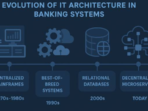
Banks often have decades of accumulated processes, integrations, data structures, and regulatory requirements.
Common challenges include:
- Legacy system dependencies
- Data migration
- Integration with payment networks
- Regulatory requirements
- Downtime concerns
- Security risks
- Vendor dependencies
- Employee skills
- Cost management
The BIS has highlighted digitalization and replacement of legacy systems as part of broader efforts to strengthen banking capabilities and operational resilience.
Read Also: Core Banking Architecture: Building a Modern, Scalable Banking System
For many institutions, a gradual modernization strategy can be more practical than attempting to replace every component simultaneously.
Best Practices for Core Banking Architecture
A strong architecture should be designed around business capabilities rather than technology trends alone.
Key practices include:
- Define clear service and domain boundaries.
- Protect the ledger and transaction-processing layer as critical infrastructure.
- Use APIs to create controlled integration points.
- Apply strong identity and access management.
- Separate transactional workloads from analytical workloads where appropriate.
- Build monitoring and auditability into every critical service.
- Design for failure instead of assuming perfect availability.
- Test disaster recovery regularly.
- Document dependencies between systems and third parties.
- Modernize legacy components incrementally when possible.
The Basel Committee’s operational-risk principles also stress that governance, ICT, business continuity, and risk management should work together rather than operate as isolated disciplines.
The Future of Core Banking Architecture
The future of banking architecture is likely to be more modular, API-driven, event-aware, data-intensive, and cloud-enabled. At the same time, the industry’s focus on resilience means that speed cannot come at the expense of security and reliability.
Artificial intelligence, real-time payments, open banking, embedded finance, and advanced analytics will continue creating new demands on core systems. The architecture must therefore support innovation while keeping the financial ledger stable and trustworthy.
The most successful approach will not necessarily be the architecture with the most microservices or the newest technology. Instead, it will be the architecture that provides the right balance between scalability, security, performance, resilience, flexibility, and operational simplicity.
Conclusion
Core Banking Architecture is the foundation that connects a bank’s customers, applications, transactions, data, and financial operations. Traditional monolithic systems can still have a role, but modern banking increasingly requires modular components, APIs, event-driven communication, cloud capabilities, and strong security controls.
The most important lesson is that architecture should serve the banking business rather than technology for its own sake. A well-designed platform should process transactions accurately, support digital experiences, integrate with external ecosystems, protect sensitive information, and continue operating when individual components fail.
As banking becomes increasingly digital, the quality of the underlying architecture will directly influence how quickly financial institutions can innovate while maintaining the trust and reliability that customers expect.