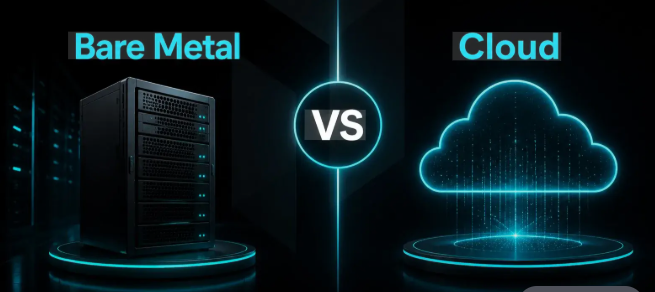
Virtual infrastructure allows multiple applications to share the capacity of the same server. As a result, banks can improve hardware utilization and reduce the number of physical servers needed for certain workloads.
For example, imagine a data center with 10 servers, each having an average CPU utilization of 20%. A considerable amount of computing capacity remains unused. Virtualization can help consolidate several workloads to make better use of available resources.
However, cost savings do not happen automatically. Expenses related to hypervisor licenses, management platforms, shared storage, and technical expertise must also be taken into account.
The Role of Bare Metal and Virtual Infrastructure in Banking Systems
These two approaches serve different purposes in supporting banking operations. The choice usually depends on application characteristics, service criticality, and data management requirements.
Bare Metal for Core Transaction Systems
A core banking system is one of the most important components of banking operations. It handles various activities, including transaction recording, balance updates, payment validation, and account management.
In certain environments, bare metal can be used to support applications with specialized computing requirements. Direct hardware access allows resources to be managed in a more controlled way.
Some reasons banks consider bare metal for critical systems include:
- The need for consistent performance.
- Greater control over hardware configurations.
- Specific resource isolation requirements.
- Fewer additional layers in the processing path.
However, core banking systems do not always have to run on bare metal. Many modern implementations also use virtualization with configurations designed to meet performance and service availability requirements.
Virtual Infrastructure for Digital Banking Services
Digital banking services have dynamic computing requirements. The number of users can increase at certain times, especially when customers make transfers, payments, or check their balances simultaneously.
Virtual infrastructure helps banks manage these requirements through resource allocation and application capacity management.
Examples of its use include:
- Running mobile banking applications.
- Supporting internet banking services.
- Operating transaction notification systems.
- Providing application testing environments.
- Running analytics and reporting applications.
- Supporting customer activity monitoring systems.
With this approach, technology teams can create application environments more flexibly without having to provide one physical server for every requirement.
Statistics and Trends in Banking Infrastructure Usage
The development of banking technology infrastructure is closely connected to the growth of cloud computing, virtualization, and data center modernization.
According to the Flexera 2024 State of the Cloud Report, 89% of the surveyed organizations had adopted a multicloud strategy, while 73% were using a hybrid cloud approach. These figures show that using multiple computing environments has become part of modern organizations’ technology strategies.
These percentages do not specifically represent the banking industry, but they provide a broader picture of the direction in which digital infrastructure is developing.
Some trends relevant to banking requirements include:
1. Growing Adoption of Hybrid Infrastructure
Hybrid infrastructure combines on-premises data center environments with cloud services. This approach allows banks to keep certain systems within their internal infrastructure while taking advantage of cloud flexibility.
For example, systems with specific control requirements can remain in internal data centers, while development and testing environments can use cloud-based virtual infrastructure.
2. Better Utilization of Server Resources
Virtualization helps organizations improve hardware utilization through server consolidation.
For example, if a server previously ran only one application with an average utilization rate of 15%, consolidating multiple applications can increase hardware utilization. However, the final results depend on the CPU, RAM, storage requirements, and activity patterns of each application.
3. Increasing Demand for System Availability
Digital banking services must remain consistently accessible. Infrastructure disruptions can affect transactions and the overall customer experience.
For this reason, banks need redundancy, backup, monitoring, and disaster recovery mechanisms. Virtual infrastructure can help through virtual machine migration and centralized management of computing environments. Meanwhile, bare metal can also be designed with redundancy at the hardware and network levels.
Challenges of Implementing Bare Metal and Virtual Infrastructure
Although both approaches offer benefits, their implementation still comes with challenges that banking institutions need to consider.
Challenges of Bare Metal
Some potential challenges include:
- Hardware investment requirements: Banks need to allocate budgets for purchasing and replacing servers.
- Capacity expansion: Adding resources requires the procurement of physical hardware.
- Infrastructure maintenance: Hardware management requires technical personnel and proper maintenance procedures.
- Resource utilization: Dedicated servers may have unused resources when workloads decrease.
Challenges of Virtual Infrastructure
Virtual infrastructure also comes with its own challenges, such as:
- Management complexity: Administrators need to understand hypervisors, virtual networks, and shared storage.
- Resource contention: Several virtual machines may experience performance degradation when using the same physical resources.
- Hypervisor security risks: Vulnerabilities in the virtualization layer may affect the environments running on top of it.
- Dependence on physical infrastructure: A failure in the host server can affect several virtual machines at once if redundancy mechanisms are not available.
Which Is More Suitable for Banking Technology?
There is no single approach that is always better for every banking technology requirement. Bare metal and virtual infrastructure both offer advantages that can be used depending on application characteristics.
Bare metal is more relevant when banks need direct hardware access, deeper configuration control, and consistent performance for specific workloads.
On the other hand, virtual infrastructure is more suitable for environments that require flexibility, server consolidation, and the management of multiple applications with different resource requirements.
In practice, banks can combine both approaches through a hybrid infrastructure strategy. Systems that require specialized computing characteristics can use bare metal, while supporting applications, development environments, testing systems, and certain digital services can run in virtual environments.
Before making a decision, several aspects need to be evaluated:
- Application characteristics: Does the application require specialized performance or flexible capacity?
- Security requirements: What level of isolation and access control is needed?
- Infrastructure capacity: Can the hardware handle increasing workloads?
- Long-term costs: What are the investment, licensing, maintenance, and operational requirements?
- Service availability: What redundancy and recovery strategies are in place when disruptions occur?
Conclusion
Bare metal and virtual infrastructure are two important approaches in the development of modern banking technology. Bare metal provides direct hardware access and greater infrastructure control. Meanwhile, virtual infrastructure offers flexibility in resource allocation, application management, and server utilization.
These two approaches do not have to be treated as technologies that replace one another. Banks can combine them based on system requirements, transaction characteristics, security needs, and digital service development strategies.
With proper planning, choosing the right infrastructure can help banking institutions build computing environments that are more efficient, stable, and ready to handle the growth of digital transactions.