LIPOSONLINE.COM – Modern banking applications rarely depend on a single system. A mobile banking transaction can pass through authentication services, APIs, payment systems, fraud detection engines, databases, and external services before the customer sees a result.
That complexity makes it difficult to understand where a problem actually occurs. Distributed tracing in banking gives technology teams a way to follow a request across these connected services and identify delays, failures, and performance bottlenecks.
What Is Distributed Tracing in Banking?
Distributed tracing in banking is an observability technology used to track a single request as it moves through multiple services in a banking application.
Instead of looking at each application separately, engineers can follow the complete path of a transaction.
For example, when a customer checks their account balance through a mobile banking application, the request might travel through:
- Mobile application
- API gateway
- Authentication service
- Account service
- Core banking system
- Database
- Monitoring and logging systems
Each part may process the request at a different speed.
Distributed tracing connects these activities into one trace, allowing engineers to see how the request moved through the system and where problems appeared.
This becomes particularly valuable as banks adopt cloud computing, APIs, containers, and microservices.
Why Banking Systems Need Distributed Tracing
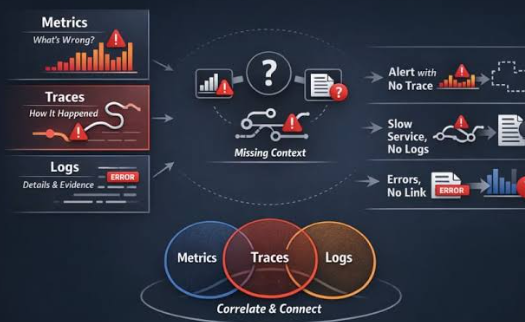
Traditional monitoring methods can show that a service is experiencing high latency, but they may not explain why.
Imagine a banking API takes three seconds to respond. Monitoring might show that the API is slow, but the actual cause could be a database query, authentication service, third-party API, or another internal dependency.
Distributed tracing provides deeper visibility.
A trace can reveal that:
- The customer’s request reaches the API gateway.
- Authentication takes 200 milliseconds.
- The account service takes 300 milliseconds.
- A database query takes 2.2 seconds.
- The response returns to the customer.
The bottleneck is immediately easier to identify.
This is particularly important for financial institutions because digital banking applications often depend on many interconnected services.
According to CNCF research, Kubernetes and cloud-native technologies have become widely adopted across the technology industry. This broader shift toward distributed infrastructure makes observability increasingly important for organizations operating complex applications.
How Distributed Tracing Works
Distributed tracing generally works by attaching a unique identifier to a request.
As the request moves between services, that identity is passed along.
Traces, Spans, and Context
Three concepts are particularly important.
Trace: Represents the complete journey of a request.
Span: Represents an individual operation within that journey.
Trace context: Carries information that allows different services to associate their operations with the same request.
For example, a banking payment request could produce a trace containing several spans:
- Authentication span
- Customer validation span
- Payment processing span
- Fraud-check span
- Database span
- Notification span
If the entire request takes 1.5 seconds, engineers can inspect each span to determine which operation contributed most to the delay.
Distributed Tracing and Microservices Banking
Microservices architecture has changed how many modern applications are developed.
Instead of building one large application, functionality can be divided into smaller services.
A banking platform might have separate services for:
- Customer accounts
- Authentication
- Payments
- Cards
- Notifications
- Fraud detection
- Customer profiles
This architecture can improve flexibility and scalability, but it also creates more dependencies. A single customer action may involve 10, 20, or even more service interactions depending on the architecture.
That is where distributed tracing becomes valuable.
Finding Service Dependencies
Tracing allows engineering teams to understand which services depend on each other.
For example:
Mobile Banking → API Gateway → Authentication → Account Service → Core Banking API → Database
If the core banking API suddenly becomes slow, traces can show how that delay affects other services.
Detecting Failed Requests
Not every problem appears as a complete system outage. A service may successfully process 99% of requests while failing on the remaining 1%.