For a banking application processing millions of requests, even a 1% failure rate could represent a significant number of affected transactions. Distributed tracing helps engineers investigate those individual failures instead of looking only at overall uptime.
Key Benefits of Distributed Tracing in Banking
1. Faster Troubleshooting
One of the biggest advantages is reducing the time required to identify technical problems. Without tracing, engineers may need to compare logs from multiple systems manually.
With tracing, related operations can be viewed as part of the same request. This can reduce investigation time from hours to minutes in well-instrumented environments.
2. Better Performance Monitoring
Banking applications need predictable performance.
A system that works correctly but takes several seconds to respond can still create a poor customer experience.
Tracing helps teams measure latency at the individual service level.
For example, an engineering team might discover that:
- Authentication contributes 15% of latency
- Payment validation contributes 20%
- Database operations contribute 50%
- Other services contribute 15%
These percentages make it easier to prioritize optimization efforts.
3. Improved Reliability
Reliability is critical for digital banking. Customers expect applications to remain available when checking balances, transferring funds, or managing accounts.
Distributed tracing can reveal recurring failure patterns before they become larger incidents.
If 5% of requests involving a particular service consistently experience delays, engineers can investigate the underlying issue before the problem becomes more widespread.
4. Greater Visibility Across Cloud Systems
Many financial institutions are adopting cloud infrastructure and hybrid environments. A transaction may move between on-premises banking systems and cloud-based applications.
Tracing provides a common way to observe the request across those environments. This is especially useful when traditional monitoring tools are limited to individual infrastructure components.
Distributed Tracing vs Logging and Metrics
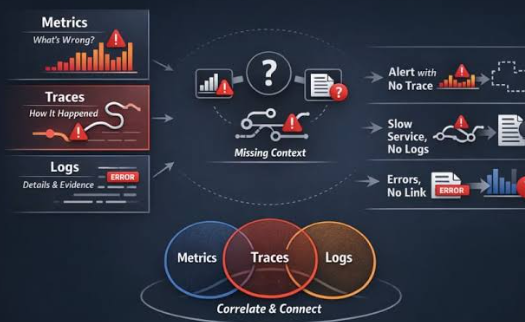
Distributed tracing is not designed to replace logs or metrics. Instead, the three technologies complement each other.
Logs
Logs record individual events.
They can contain detailed information about errors, application activity, and system events.
Metrics
Metrics provide numerical measurements such as:
- CPU usage
- Request rate
- Error rate
- Response time
- Memory usage
Traces
Traces show how a request travels through multiple services. A useful observability strategy combines all three.
For example, a metric might show that payment latency increased by 30%. A trace can identify which service caused the increase, while logs can provide detailed information about the error.
OpenTelemetry and Banking Observability
OpenTelemetry has become an important open-source framework for collecting telemetry data. It supports traces, metrics, and logs and provides a standardized approach to instrumentation.
For banks operating applications across multiple platforms, standardization can reduce dependency on a single monitoring technology.
OpenTelemetry is now part of the Cloud Native Computing Foundation ecosystem and has gained broad adoption across cloud-native development. The key advantage is interoperability.
A financial institution can instrument applications using OpenTelemetry and send telemetry data to different observability platforms depending on its technical requirements.
Security Considerations for Banking Tracing
Distributed tracing introduces an important challenge: traces can contain sensitive information.
A trace might reveal:
- Customer identifiers
- Account-related information
- Internal service names
- Request parameters
- Transaction metadata
Financial institutions therefore need strict controls over telemetry data.
Protecting Trace Data
Banks should consider:
- Data masking
- Encryption
- Access controls
- Retention policies
- Sensitive-field filtering
- Audit logging
Not every piece of application data needs to appear in a trace. Good tracing practices collect enough information to diagnose technical problems without unnecessarily exposing sensitive customer information.
Distributed Tracing and Banking Performance
Performance optimization is one of the strongest practical applications of tracing. Consider a digital banking request that normally completes in 800 milliseconds but suddenly rises to 2 seconds.
A distributed trace might reveal that the additional 1.2 seconds comes from a third-party verification service. Instead of optimizing the entire application blindly, engineers can focus on that dependency.
This targeted approach can make performance improvements more efficient. For example, if one service accounts for 60% of total request latency, improving that service may produce a much larger benefit than optimizing several components that each contribute only 5%.
Challenges of Implementing Distributed Tracing
Distributed tracing is powerful, but implementation requires planning.
Instrumentation Complexity
Every important service needs appropriate instrumentation.
Large banking environments can contain hundreds of applications, making full implementation a significant technical project.
Data Volume
High-traffic systems can generate enormous amounts of telemetry. A bank may need sampling strategies to control storage and processing costs.
For example, instead of recording 100% of routine requests, an organization might capture a smaller percentage of successful requests while retaining a much higher percentage of traces associated with errors.
Legacy Systems
Older banking platforms may not support modern observability standards easily. Banks may need additional integration layers to connect legacy systems with newer tracing infrastructure.
The Future of Distributed Tracing in Banking
As banking technology continues moving toward cloud-native platforms, APIs, and microservices, distributed tracing will become increasingly important.
Future observability platforms are likely to combine tracing with artificial intelligence and machine learning.
AI-assisted observability could help identify patterns such as:
- Repeated service failures
- Unusual latency increases
- Dependency bottlenecks
- Abnormal transaction workflows
- Emerging infrastructure problems
Instead of waiting for engineers to manually investigate every alert, intelligent systems could prioritize incidents based on potential impact.
The broader observability market is also expanding as organizations manage increasingly complex distributed applications. This trend is particularly relevant to financial institutions, where system reliability and transaction performance directly affect digital customer experiences.
Conclusion
Distributed tracing in banking provides visibility into how requests move through complex financial applications. By connecting operations across APIs, microservices, databases, cloud platforms, and legacy systems, tracing helps engineering teams understand where failures and performance problems originate.
Its value becomes especially clear when banking applications contain dozens or hundreds of interconnected services. Logs can explain individual events, metrics can reveal overall system conditions, and traces can show the complete journey of a request.