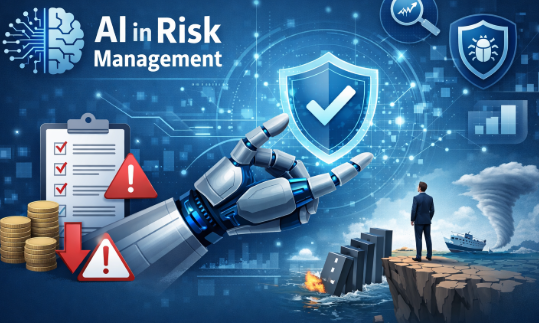
This illustrates an important point: identifying a risk is not the same as managing it.
A Practical AI Risk Management Framework
Organizations do not necessarily need a complicated process to begin managing AI risks. A structured lifecycle can make the work easier.
Step 1: Identify the AI System and Its Purpose
Start by documenting what the AI system does, what decisions it influences, who uses it, and what data it processes.
Read Also : Generative AI in Banking: How AI Is Transforming the Future of Financial Services
A customer-service chatbot, for example, may have very different risks from an AI system used to support financial decisions.
Step 2: Identify Potential Risks
Create a risk inventory covering areas such as:
- Privacy.
- Security.
- Accuracy.
- Bias.
- Compliance.
- Transparency.
- Operational reliability.
- Third-party dependencies.
The goal is to identify risks before deployment rather than waiting for an incident.
Step 3: Assess Probability and Impact
Not every risk deserves the same level of attention.
A simple assessment can consider two dimensions:
Risk level = likelihood × potential impact
A low-probability event with minimal consequences may require basic monitoring, while a moderately likely issue with significant consequences may require stronger controls and human oversight.
Step 4: Apply Controls and Safeguards
Controls should match the specific risk.
For example, privacy risks may require stronger access controls and data minimization, while model reliability risks may require additional testing and human review.
The most effective programs usually combine technical controls with organizational policies and clear responsibilities.
Step 5: Monitor AI Continuously
AI risk management does not end when a model goes live.
Performance can change as user behavior, data, business conditions, and external environments change. Organizations should establish monitoring processes that track model performance, unusual behavior, incidents, and emerging risks.
NIST’s AI RMF is designed to support risk management throughout the AI lifecycle rather than treating risk as a one-time assessment.
Step 6: Respond and Improve
When an AI incident occurs, organizations should document what happened, identify the root cause, evaluate the impact, and improve controls.
Incident response is especially important because AI systems can evolve quickly. NIST’s recent guidance also emphasizes integrating incident response into broader cybersecurity risk management activities.
AI Risk Management for Generative AI
Generative AI introduces several additional challenges because these systems can create text, images, code, audio, and other content dynamically.
Common risks include inaccurate outputs, privacy issues, harmful bias, intellectual property concerns, prompt manipulation, and inappropriate use.
NIST released its Generative AI Profile in 2024 as a companion to the AI RMF, specifically addressing risks associated with generative AI.
Organizations using generative AI should consider controls such as:
- Human review for important outputs.
- Restrictions on sensitive information.
- Output testing and validation.
- Clear acceptable-use policies.
- Monitoring for misuse.
- Employee AI literacy and training.
- Documentation of approved AI applications.
The business case for these controls is strong. IBM found that 68% of surveyed CROs and CFOs felt insufficiently prepared to manage generative AI-related risks, while 70% said they lacked some of the expertise needed to keep pace with AI development and emerging risks.
How Businesses Can Build Better AI Governance
AI Risk Management works best when it is connected to broader AI governance.
A practical governance structure should define who is responsible for:
- Approving AI use cases.
- Assessing risk before deployment.
- Monitoring model performance.
- Reviewing incidents.
- Managing third-party AI providers.
- Updating policies.
- Communicating risks to leadership.
This does not mean every AI project needs a large committee. Smaller organizations can begin with a clearly defined owner, a documented risk checklist, regular reviews, and escalation procedures.
The Future of AI Risk Management
AI Risk Management will become increasingly important as organizations move from AI experiments to larger-scale deployment.
The biggest shift is likely to be from reactive risk management toward continuous evaluation. Instead of testing a model once and assuming it will remain safe, organizations will increasingly monitor AI systems throughout their operational life.
NIST is already expanding its AI risk work. In April 2026, it released a concept note for an AI RMF profile focused on trustworthy AI in critical infrastructure, while the broader AI RMF 1.0 is also being revised.
This suggests that AI risk management will continue evolving alongside the technology itself.
Final Thoughts on AI Risk Management
AI offers enormous opportunities, but responsible adoption requires more than choosing a powerful model. Organizations need to understand how AI systems can fail, who could be affected, and what safeguards should be in place.
AI Risk Management provides the structure for doing exactly that. By combining risk identification, data protection, security testing, fairness evaluation, human oversight, continuous monitoring, and clear governance, organizations can make AI safer and more reliable.
The strongest approach is not to treat risk management as something that slows innovation. Done properly, it can actually support innovation by giving organizations greater confidence to deploy AI responsibly. As AI becomes more deeply integrated into business and society, the ability to manage its risks will become just as important as the ability to build the technology itself.